My friend Sherri shares her thoughts with us today on going back to basics.
“You’d be surprised. It’s more simplistic than you think.
Cooking: Dishes served would (and should) be very basic. No need to adhere to a special recipe. And no one would need to eat like we do today.
Most anything can be slow-simmered.
Most anything can be slow baked, or roasted, at no particular temperature… just until done.
Meals would be based around what you’d have on hand. So, substitutions wouldn’t really be an issue. You’d simply cook with what was in the cupboard – and become more inventive as you went along.

Straight-up meats, seasoned as you like (or can afford), with straight-up vegetables as sides. No convenience mixes. No fancy sauces. Even a carb for every meal would not be needed. Our diets would adjust.
For instance: Choose your carb. Or skip it altogether, several times a week. No one really needs sandwich bread, dried pasta, rice and potato flakes, if you run out of one or more. And things would run out. It might take a year or more to replenish certain things – if and when available, or trade-able. Just like the old days.
If I made noodles or biscuits, I’d make enough for two days, and use part of the dough for hand pies, using my dehydrated fruits – or for savory pies, using my dried vegetables and meat scraps (or rehydrated dried meats).
As the cook, I could afford to eat a bit less, because I’d be sample tasting just about everything, and not wasting extra pot-liquor or scraps. More servings for the children and (working) menfolk, at meal times… just like the old days.

Any pot will do!! Most any type of cookware can be placed on hot embers, with great success. You could completely do without cast iron, if cooking in a fire pit. Not many folks know that.
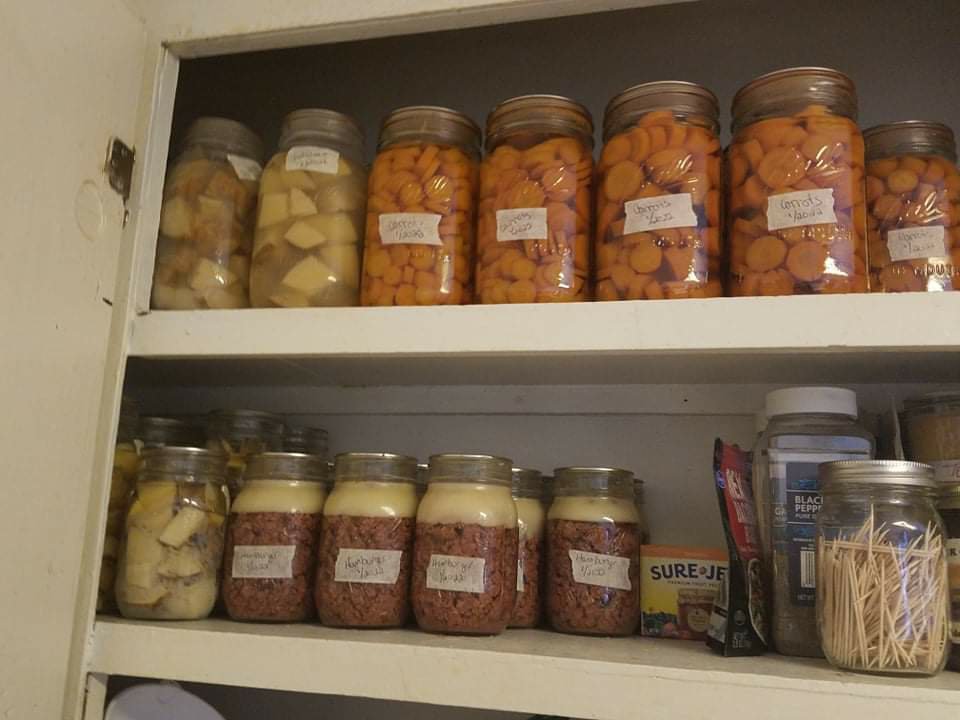
We’d not be having Mylar, 02 absorbers, Gamma lids, dessicants, or even vacuum sealers (unless you had a brake bleeder, or reverted back to the non-preferred dry oven sealing). Spare jars would be nonexistent for awhile. As would lids. Our kitchen or yard duties would forever include dehydrating spare foods, to be used within the year – winter months, especially. And just like the squirrels, we’d replenish in the spring.
Wood collection is, and would be arduous. But it’d be a necessary and frequent task. Same with gardening. Same with raising animals. You’d burn many calories, just doing these three things throughout each week. And much more if and when hunting, butchering, fishing, smoking, and preserving all of your bounty.
You’d learn to live, eat, and preserve along with each seasons’ bounty. Nature provides us with the right protein, the proper vitamins and minerals we need for and during the very seasons that we need them. There’s a reason certain things grow during certain seasons… that’s when we really need them the most! Eat your fill during each harvest, and then preserve any bounty.
You might need to be a bit nomadic, to take full advantage of those seasons and different foods. You may also need to walk 5 miles to trade with someone who has a cow, for dairy requirements- a true luxury!!
You may need to learn such skills as becoming a wheelwright, to make your own pull-carts, or wagons. Fashion your own weapons or tools. Skin your own hides in the winter.
But no man is an island:
You may need to help others build, time and time again. Such as a milling wheelhouse on the local river, to help your community ship in and grind grains. Just like the old days – not every household did all of their own provisions. Some things, in the larger picture, take an entire community.
Our earliest pioneers did these things, and more. That’s how villages thrived. And that’s why you and I are here today – by their successes. Even way, way back in the old days of the 1700s through the early 1900s, there were leather makers, wagon makers, shoe cobblers, teachers, preachers, carpenters, brick masons, blacksmiths, wood stove makers, miners, scientists, alchemists, druggists, watch makers, quilters and fabric spinners, seamstresses, knitters, midwives, physicians, railroad men and engineers, undertakers, merchants, traveling trinket salesmen, cattle ranchers, horse traders, goat shepherds, hospitals, school and even universities! But 99% of all of them, were also farmers, in addition to their specialized skill (if any).

Gardens and farms feed the family, and sometimes the community, in times of bounty. But skills can be a valuable commodity – if the man is not an island unto himself. The hermit would not do as well as the wise one who could benefit from co-mingling. This has been proven time and time again.
A Back to Basics lifestyle is not that bleak. It would require hard and constant work, though – I kid you not. No amount of fear, worry, stress, or freaking out would be beneficial. It’d simply be a case of ‘do or die’.
Personally, I would not use the 4-letter acronym to describe that day when our world stops, and a more primitive lifestyle such as this came around. Nay… the acronym would only apply to the day one might not succeed at it. I will not sit down and cry my tears into the dirt. I’ll plow it. If I have nothing at all to my name – being destitute and scared – at least I can get up out of my pity-pool and remove the rocks, stumps and boulders, along with my fears, and prepare my fields for a later time of hopeful bounty.”
Let’s Chat! We’ve spilled our beans on the basics, now it’s your turn. Ever daydreamed about a simpler life? Got a back-to-basics tale of your own? Or maybe you’ve got some good ol’ wisdom to share? Drop your thoughts in the comments below – we’re all ears (or eyes, in this case). And for those who enjoy a hearty mix of farm tales, quirky insights, and the occasional duck pic, make sure to quack along with us on Facebook and Instagram. Dive into our daily farm antics and stay updated with all things Huckleberry. See you in the fields… or, y’know, online! 🌾👩🌾📱
